Welcome back to looptorrent.net. I hope your music production journey is going well and you’re making consistent progress.
In this article, we’ll take a detailed look at the features of the Oeksound Soothe2 plugin. By the end, you’ll have a clear understanding of how to use it effectively, along with the core concepts behind its operation.
We’ll cover the following topics in a structured way:
- A breakdown of dynamic EQ and how it works
- Key features of Soothe2
- Practical applications and real-world use cases
- An honest review based on experience
- A final conclusion to wrap everything up
Before diving into the plugin itself, it’s important to understand the mechanics behind dynamic EQ, since Soothe2 is built on similar principles.
Mechanics Of Dynamic EQ :
A dynamic EQ is designed to adjust its frequency response automatically depending on the incoming audio signal. Unlike traditional EQs, which apply fixed boosts or cuts, dynamic EQ reacts in real time to changes in the sound.
In the early days of audio processing, engineers relied heavily on static EQs. These equalizers applied a fixed adjustment that remained constant throughout the signal. For example, if a harsh frequency appeared around 13 kHz, you might reduce it by a set amount, such as -5 dB.
While this approach helps control harshness, it has a limitation: the EQ continues to affect that frequency even when the harshness is no longer present. This can unintentionally reduce desirable tonal elements, resulting in a loss of clarity and natural balance in the mix.
Dynamic EQ solves this issue by introducing threshold-based processing, similar to a compressor. Instead of applying a permanent cut, the EQ only activates when the signal exceeds a certain level. This allows it to target problematic peaks while leaving the rest of the audio untouched.
This makes dynamic EQ far more precise and musical compared to static EQ. A modern example of this concept is Soothe2, which goes beyond traditional dynamic EQ by focusing on resonance suppression and intelligent frequency control.
Introduction of the Oeksound Soothe2 :
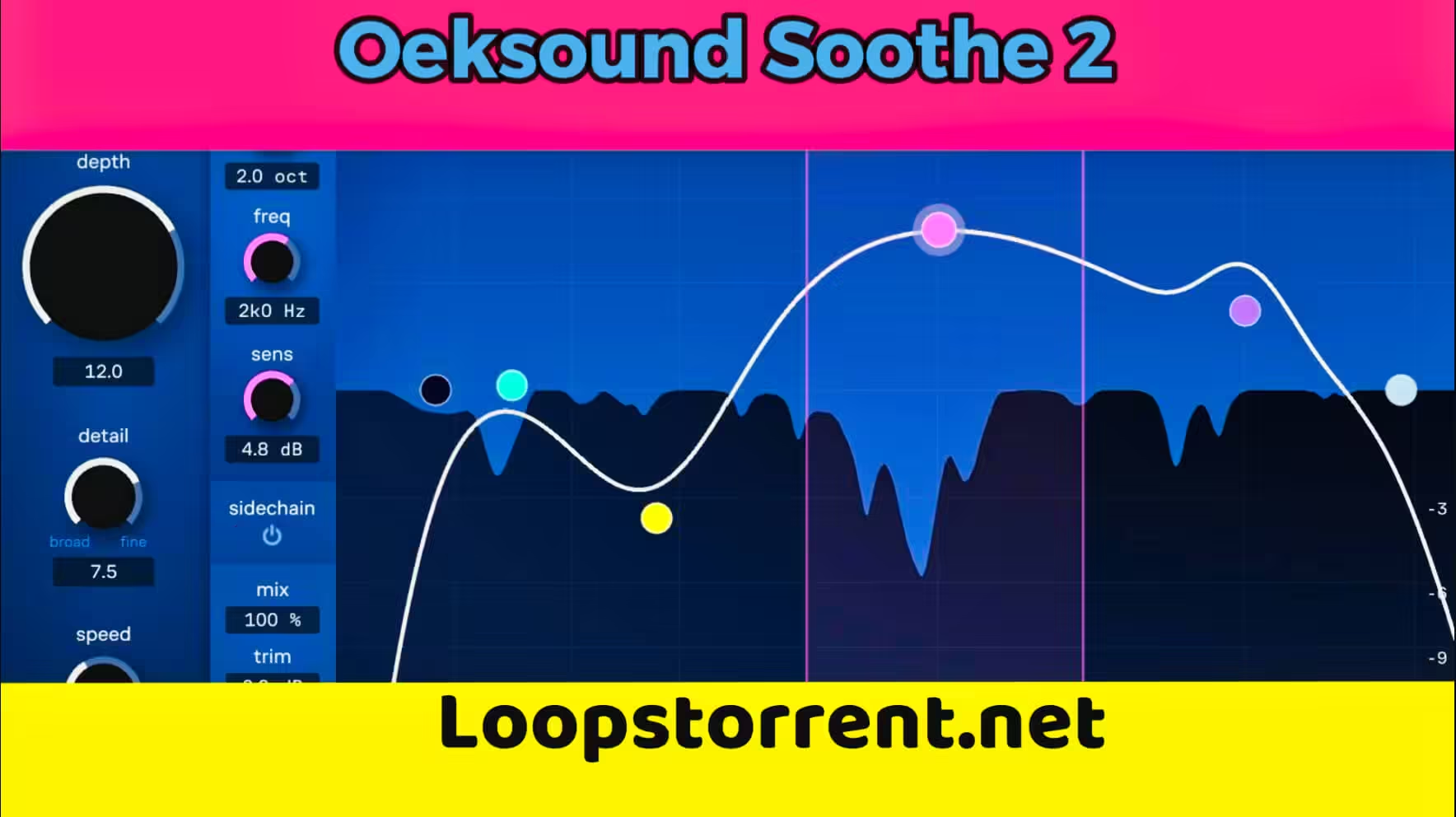
Oeksound Soothe2 is an advanced audio effect plugin designed primarily for smoothing out harshness and controlling resonant frequencies in a mix.
Although there are many EQ plugins available today, Soothe2 stands out because of its ability to automatically analyze incoming audio and adjust its processing in real time. Instead of manually hunting for problem frequencies, the plugin identifies and reduces them dynamically.
This behavior significantly improves workflow by saving time and reducing the need for precise manual EQ adjustments. For producers and engineers, this means faster mixing decisions and a more efficient production process.
Key Features of the Plugin:
- Soothe2 comes with a range of features that make it a powerful tool for modern mixing and mastering workflows:
- Automatic Resonance Detection
The plugin intelligently identifies harsh or problematic frequencies and applies targeted reduction. - Natural Sounding Processing
It reduces frequencies without introducing noticeable coloration, helping preserve the original character of the audio. - Fully Customizable Controls
Users can fine-tune how the plugin behaves, allowing for both subtle and aggressive processing depending on the situation. - User-Friendly Interface
The interface is clean, intuitive, and easy to navigate, making it accessible even for beginners. - Advanced Sidechain Filtering
You can make the plugin respond to specific frequency behaviors using sidechain input, offering more control over how it reacts. - Attack and Release Controls
These parameters allow you to shape how quickly the plugin responds to changes in the audio signal, especially useful for transient-heavy material. - Resizable Interface
The UI can be adjusted to fit different screen sizes and workflows. - Preset Library
Comes with professionally designed presets that can be used as starting points for various scenarios. - Frequency Preview Mode
One of the most useful features allows you to monitor which frequencies are being processed, helping you make more informed adjustments.
Applications and Use Cases:
It is widely used in both mixing and mastering due to its ability to control harshness with precision.
Vocal Processing
Vocals often contain harsh resonances, especially in home or budget recordings. These issues can occur due to microphone quality, room acoustics, or recording techniques.
Soothe2 helps smooth out these harsh frequencies, resulting in cleaner, more professional-sounding vocals without over-processing.
Instrument Mixing
Instruments such as guitars, synths, and drums can also produce unwanted resonances. Soothe2 can be used to refine these elements and ensure they sit well in the mix without clashing frequencies.
Mastering
During mastering, controlling harsh frequencies becomes more challenging because all elements of the track are combined into a single stereo file. Soothe2 can help gently reduce problematic resonances across the entire mix while maintaining balance and clarity.
De-essing
While traditional de-essers target specific sibilant frequencies, Soothe2 can perform a more adaptive form of de-essing by dynamically reducing harsh high frequencies in a more transparent way.
Honest Review of Soothe2
Disclaimer:
The following reflects my personal opinion. I was not paid or sponsored to write this review. The goal is to share an honest perspective that may help others decide whether this plugin is suitable for their workflow. Individual experiences may vary.
Over time, I faced challenges dealing with harsh frequencies in my mixes. Initially, it required a lot of manual effort to identify and fix these issues using traditional EQ techniques.
After discovering Soothe2, my workflow improved significantly. The plugin helped me quickly identify and control resonant frequencies with minimal effort.
Rather than relying on it completely, I use Soothe2 as a supportive tool. It acts as a guide for locating problematic frequencies while still allowing me to make final decisions manually.
In practice, I treat it as a reference rather than a replacement for critical listening. However, it has undeniably saved a considerable amount of time and improved my overall efficiency.
For Producers on a Budget
If you are a self-producing artist working with limited time or resources, Soothe2 can be a valuable investment.
Many producers spend hours manually adjusting EQ settings just to control harshness and improve clarity. Soothe2 simplifies this process and speeds up workflow significantly.
While it is often used as an advanced corrective tool, it can also function as a highly precise dynamic EQ when needed. Whether you are a beginner or an experienced producer, it can fit into a wide range of production environments.
Technical Details & System Requirements
- Format : VST, VST3, AAX
- Bit depth: 64bit
- System requirements: Windows 7 and up as 32 / 64-bit VST and VST3, and 64-bit AAX (PT11 and up).
Alternatives
To my opinion, if anyone can’t afford this plugin then he should use the follow free alternatives
Paid Plugins:
- FabFilter Pro-Q 3
- iZotope Neutron
- Waves F6 Floating-Band Dynamic EQ
- Sonnox Oxford Dynamic EQ
- TDR Nova
- DMG Audio EQuilibrium
- Sonible smart2
- MeldaProduction MAutoDynamicEQ
- Soundtheory Gullfoss
- Accusonus ERA 4 Voice Leveler
Free Plugins:
- Tokyo Dawn Labs TDR VOS SlickEQ
- TDR Nova (Free version)
- MeldaProduction FreeEffectsBundle
- ReaEQ (Part of Reaper’s plugin suite)
- Blue Cat’s Triple EQ
- Voxengo Marvel GEQ
- Youlean Loudness Meter (Includes EQ features)
- TDR Molotok (Part of TDR’s free bundle)
- Nova-67P (Parallel dynamic EQ)
- TDR Kotelnikov Junior